


Google Ads
Be Seen First
PPC or Google Adwords is an online advertising platform developed by Google, where business owners pay to display brief advertisements, service offerings, product listings and video content to show their products. The reason? Simply to increase the chances of generating online sales. Simple it may sound, but simple to execute successfully it is not!
PPC is one of the most powerful tools out there when it comes to marketing. Yes, it’s easy to set up a PPC campaign, the problem is it takes no time at all for the costs to spiral out of control. It takes experienced hands to run a profitable campaign, making sure it’s performing to maximum efficiency while keeping those costs down. We have experts that have been training with Google since the start to keep you up to date with the latest techniques to ensure you don’t over spend but still see the returns you are looking for.
The good news is we understand how to achieve the best results for your paid search. A combination of strategies helps us increase clicks, reduce costs and improve conversions. The result of which drives down the cost per acquisition (CPA) and increases overall sales and return on investment (ROI). We make sure you aren’t wasting a penny.
The Top Paid Ads Get 41% More Clicks
The core campaigns to consider, when creating a successful Google Ads account include;
Retargeting
Did you know that just 2% of shoppers convert (spend money) during their first visit to an e-commerce site? The truth is the buyer’s journey is pretty convoluted. Rarely is it nice, neat and linear. So, what happens to the other 98%? At least some will certainly come back and purchase, but how can you ensure that they come back to you and not one of your competitors?
Retargeting reaches out to that 98% and brings them back to your site, thus increasing your chances of selling to them. The way it works sounds pretty high tech, but it’s actually pretty simple. The platform keeps track of your website visitors, what they view, and if they put anything in their shopping cart. Then it displays your ads for those products or services on other sites they visit online.
Google Shopping
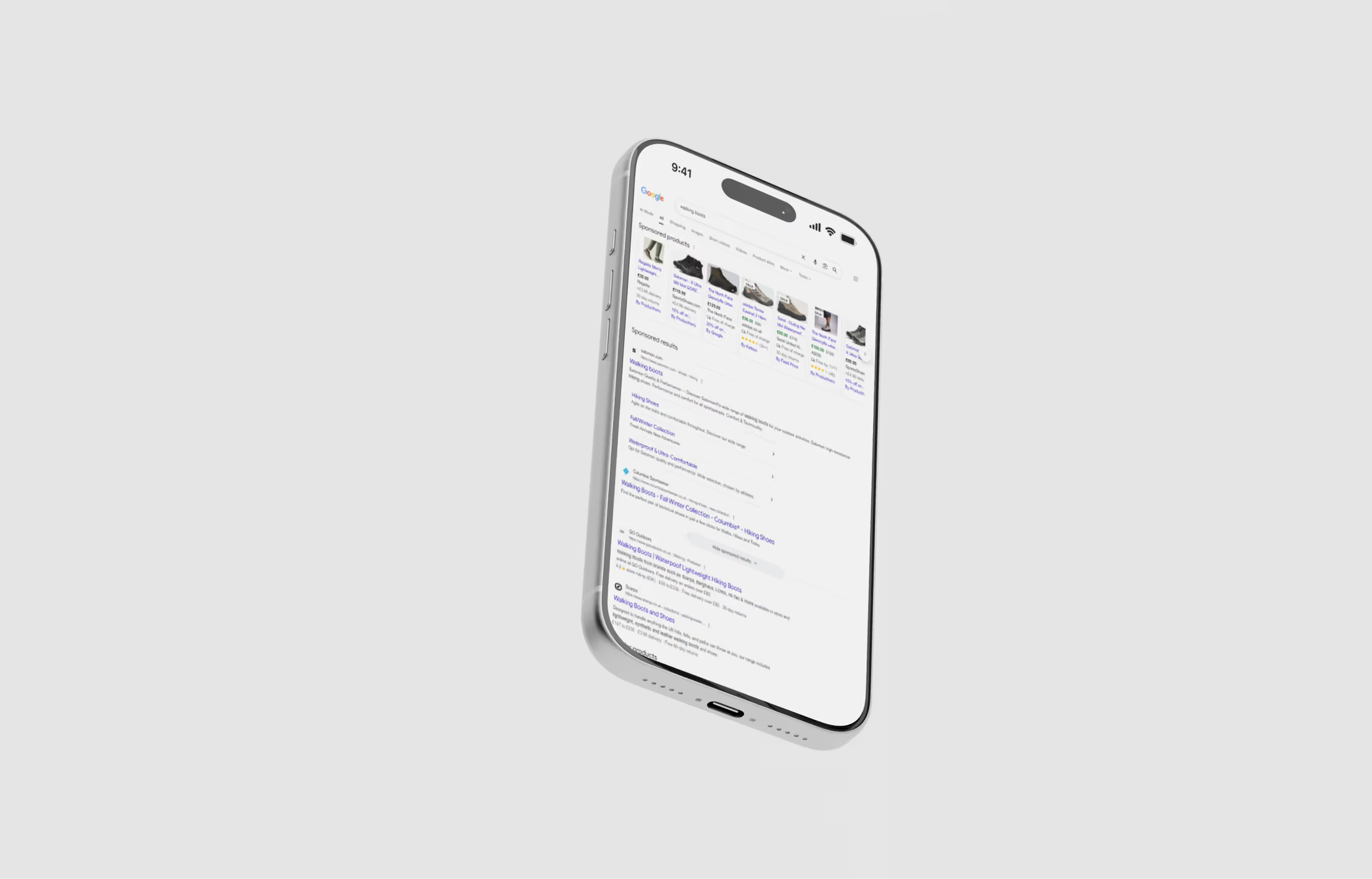
Formerly known as Product Listing Ads, Google Shopping allows customers to search for, view and compare products. These products are displayed when a customer uses Google to search for a product. They can appear in the main search engine results page or under the shopping tab.
For example, when a customer types dresses into Google, they may see sponsored ads appearing at the top of the page. For example: This is the quickest way to get your product or service seen on the first page of Google, you will be seen instantly rather than waiting for your products to move up the ranks organically, using Search Engine Optimisation SEO.
Standard Search
Search ads have three main components; a headline, display URL and description text. All designed to convince users to click through. Ad extensions can also be included to provide users with additional information. How often search ads appear, their rankings, and the cost per click all depend on the bid and Optimisation score.
Standard Search differs from Google Shopping as you don’t need to have a product to sell, as this is used when you are offering a service. It would work very well if you were an Accountant for example;
Display Ads
Although Google display advertising still originates within the Google Ads interface, display ads perform very differently from their paid search counterparts. The main difference between Google search ads vs display ads is that search ads are a form of “pull” advertising while display ads are “push” advertising. Meaning, search ads only appear to those who are already searching for your product or service, while display ads are paid placements that appear based on various targeting parameters.
Not only that, display ads aren’t limited to appearing in only one location like search ads (in the SERP). Display ads appear across the entire GDN, over 2 million sites reaching over 90% of online users. They can show in multiple places on social media, such as natively in news feeds or on the side of the main feed:
YouTube Ads
YouTube advertising all occurs online in Google AdWords. You create your videos and upload it to Google AdWords, choosing the ad targeting and placement for your ads. You bid to display the ad, paying any amount that is within your budget. Once viewers watch your ad, you pay. Once your YouTube and runs, you can view the analytics from Google AdWords. You can run, pause, and stop ads at any time.
Increasingly more small and medium-sized businesses are taking their advertising to YouTube. In fact, that number has doubled, and it’s not surprising why. There are various benefits of YouTube advertising, all of which circle around to the most important benefit: a huge audience. YouTube ads have the opportunity to appear across a platform that boasts 1.5 billion monthly viewers.
Types of Ad Targeting Options
As with other forms of social media advertising, there are multiple targeting options to choose from so you can reach your target audience with your YouTube ads.
Demographics: Target users according to their age, gender, etc.
Interests: Target users already interested in certain topics, users that are more tailored to your brand, users that like products and services similar to yours, and life events.
Video Remarketing: Target users that have interacted with your business’s videos in the past.
Placements: Target other YouTube channels, videos, apps, websites, and placements within those websites.
Topics: Target specific topics on YouTube and the Google Display Network.
Keywords: Target specific keywords related to a YouTube video, YouTube channel or website.
Performance Max
Performance Max is a goal-based campaign type in Google Ads that allows advertisers to access all of Google’s ad inventory through a single campaign. It uses Google’s advanced machine learning to automatically optimise performance across channels like Search, Display, YouTube, Discover, Gmail, and Maps. By analysing real-time signals such as user intent, location, and demographics, Performance Max dynamically adjusts bids, creatives, and placements to maximize conversions or conversion value. Advertisers provide creative assets, audience signals, and business goals, while Google’s AI determines the best combinations to reach potential customers. This campaign type is particularly effective for achieving holistic marketing goals and expanding reach beyond traditional keyword targeting.
Amazon Ads
Target Your Prime Audience
Amazon Advertising (formerly AMS or Amazon Marketing Services) is a service that works in a similar way to pay-per-click ads on Google: sellers only pay when shoppers click on ads (regardless of whether or not the item sells).
With so many users today making purchases on Amazon, how do you know if it’s right for you and your business…
Any business who wants to gain more visibility to their products on Amazon can pay for these positions by bidding on specific keywords, which will lead to higher visibility in the Amazon SERPs. The advertiser will then be charged when a shopper clicks on their ad. You can essentially see Amazon’s advertising platform as the Amazon version of Google AdWords.
There are 300 million Amazon users and counting!
If you think that Amazon Ads is a good fit for your business’s products, here are some of the types of campaigns that you should consider.
Amazon Sponsored Product Ads
Sponsored product ads operate in a similar way to ads run through the Google Shopping Network. These are the ads that drive Amazon searchers directly to a specific product you’re selling.
When shoppers click on your sponsored product ad, they’ll be directed to the ad’s product detail page. These ads are keyword-targeted, and advertisers have the option of choosing from exact, phrase, or broad match types. Advertisers also have the control of setting a daily budget, as well as the campaign duration. While the campaign can be paused at any time it must run for at least 1 day.
Headline Search Ads
Headline search ads display in the search result pages as headline banner ads always above the result listing. These ads are cost-per-click, and lead searchers to any specified page on Amazon.
This landing page is typically a customised branded page, and you’ll be directed there when you click on the headline ad.
These ads are also keyword targeted and can be used to promote 3 or more products together. Headline search ads also use a cost-per-click method. There are also only two keyword match-types supported for headline search ads – exact and phrase match. Lastly, there is a minimum campaign budget for these ads and a limit of spend per day. Campaigns can be scheduled to run up to four months in advance.
Amazon Product Display Ads
Lastly, you can use a product display ads that work a bit differently than the two ad formats above. These ads are not keyword targeted, but rather interest or product targeted display ads. They drive shoppers to the products detail page and are also priced by a cost-per-click method.
Your business can select from a long list of products (for example, similar products to what you’re selling) or interests (for example, if the shopper is interested in running) to target these ads to relevant shoppers. It’s important to note that each campaign is limited to one target type. These ads can appear to the right or at the bottom of the search results, on the customer reviews page, at the top of the offer listings page, as well as in Amazon marketing emails.